




24V 100 Amp Alternator: A Complete Guide to Performance and Applications
If you're sourcing a heavy-duty charging solution for John Deere construction or mining equipment, aalternator%20100%20amp%20&type=products"> 24v alternator 100 amp is one of the most critical components you'll evaluate. This guide covers how these units work, what separates a quality unit from a substandard one, how to install and test them, and what to look for when buying in bulk. XITU's 24V 100A alternator delivers 2.4–2.8kW of continuous power output, fits 15+ John Deere models, and is built to survive mine-site conditions that destroy lesser components.
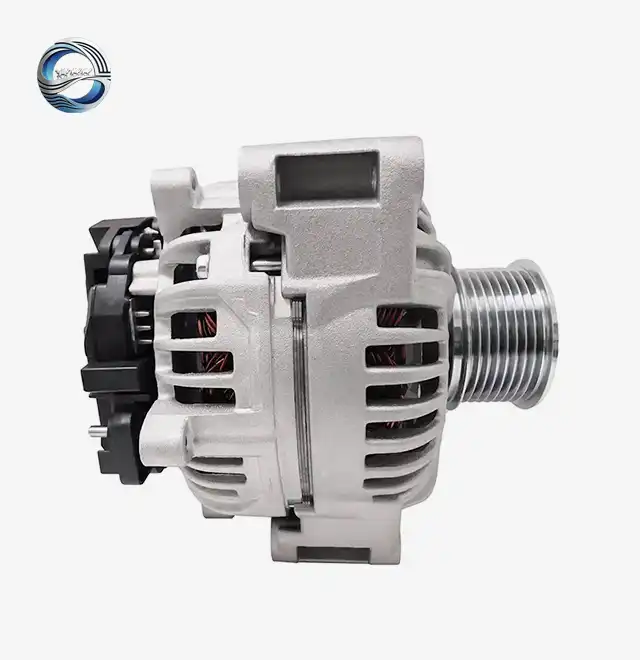
Understanding the 24V 100 Amp Alternator: Working Principles and Key Benefits
How a 24V Alternator Converts Mechanical Energy to Electrical Power
A 24V generator makes AC current by spinning a rotor inside a stator winding. An AC current converter bridge then changes the AC current to a stable DC output. At full load, XITU's unit stays at 100A from 5,000 to 6,000 RPM, with a cut-in speed of only 1,200 to 1,500 RPM. With such a low cut-in level, the battery bank starts charging as soon as the engine stops running. This is very helpful for job sites where engines are idle for long periods of time.
Why 24V Systems Outperform 12V in Heavy Equipment
The power that a 24V 100A unit makes is 2,400W. Only 1,200W are made by a 12V 100A unit. If you double the voltage for the same gage of wire, you get twice as much power. This is very important for excavators and wheel loaders that have hydraulic cooling fans, nite lighting arrays, telematics modules, and climate control all running at the same time. The higher system voltage also lowers resistive losses along long cable runs, which is very helpful for big frame machines where cable running can go over several meters.
Early Warning Signs and Maintenance Checkpoints
Finding problems with the alternator early on saves a lot of money in repairs. Keep an eye out for these signs and take action before something goes wrong:
- Dimming instrument panel lights or weak battery charge after engine warm-up signal that output current has dropped below spec — often caused by worn brushes or a failing rectifier diode.
- Unusual whining or grinding noise from the front of the engine points to bearing wear; on dusty mine sites, bearing degradation is the leading cause of early alternator failure.
- Voltage ripple warnings on the machine's ECU indicate a degraded rectifier bridge; dirty DC output can trigger false fault codes in modern electronic control systems.
Every 500 hours, you should check the tightness of the belt, look for corrosion in the terminal connections, and every 1,000 hours, use a standardized load tester to check the output voltage.
Comparison and Selection Criteria for 24V Alternators
100A vs. Higher Amperage Configurations
To choose the right output rating, you need to look at how much electricity the machine actually uses plus a safety margin. You can quickly find what you need in the table below:
| Application | Recommended Output | Typical Load Profile |
|---|---|---|
| John Deere 670G / 724K Excavator | 100A continuous | Telematics, lights, A/C, controls |
| Class 8 Long-Haul Truck (sleeper) | 130–150A | Sleeper HVAC, lift gate, refrigeration |
| Off-grid 24V battery bank charging | 100–120A | Deep-cycle bank, inverter load |
| Marine commercial vessel | 100–150A | Navigation, winch, emergency lighting |
A 24v alternator 100 amp is the right power level for most mid-range John Deere tractors and excavators. Costs and heat loads go up when you oversize, but there's no practical gain.
Brand Reliability and OEM Cross-Reference
As well as Bosch OEM numbers 0124655081, 0124655189, and 0124655190, XITU's unit also replaces RE538241, RE558676, and SE502563. For the 470G LC, 670G, 670GP, 672G, 672GP, 724K, 744K, 755K, 850K, 903K, 903KH, 909K, 909KH, 953K, and 959K platforms, these are the original part numbers that John Deere used.
In this market area, Bosch and Delco Remy make the best OEM alternators. XITU meets that standard with Class H insulation that can withstand temperatures up to 180°C, heavy-duty bearings from the 6305 series that are double-sealed, and an electronic voltage regulator (EVR) that can adjust for temperature. These are the same design principles that were used in the original Bosch parts.
Compatibility and Customization for B2B Buyers
XITU helps wholesalers and OEM/ODM clients with unique labeling for nameplates, package design, and certification paperwork. Most orders are placed for 50 to 150 units per batch, which is a reasonable amount of time to buy them. The production wait time of 30 to 60 days works with normal sea freight plans for North America, South America, and Europe.
Installation, Wiring, and Testing of 24V 100 Amp Alternators
Wiring Connections and Safety Checks
To avoid shorts, disconnect the negative battery cable before installation. For the main output, the XITU 24V 100A unit has a standard B+ terminal. The charge warning lamp has a D+ terminal, and there is a separate EVR connector. Before you place, make sure that the John Deere machine's wiring harness fits these connections. The most common mistake during installation is a mismatched ground path, which can damage the voltage regulator permanently within minutes of starting it up.
Standardized Output Testing Protocol
After installation, use an accurate inductive clamp meter and a carbon pile load tester at the B+ input to check how well it works. Goal readings: 27.5–28.5V when the engine is not running, and 100A when the engine is running at about 5,000 RPM. To keep the ECU of the machine safe, the voltage ripple should stay below 400mV peak-to-peak. If the number is outside of these ranges, the machine needs to be inspected right away before it can be used again.
After-Sales Support and Fleet Integration
A 6-month warranty from XITU covers defects that were not caused by people. If they happen, the company will replace or fix the product for free. If a fleet owner has more than 50 units, XITU's technical team can help with application engineering and batch-specific power curve data to make integration into OEM production lines or rental fleet maintenance programs easier.
Procurement Guide: Buying and Sourcing 24V 100 Amp Alternators
Evaluating Suppliers: What the Data Should Show
When looking at different 24v alternator 100 amp providers, make sure you get proof of their work before you place an order. The key proof papers and what they prove are shown below in a table:
| Document | What It Confirms |
|---|---|
| ASTM B117 Salt Spray Report (96–240 hrs) | Corrosion resistance for mine/marine environments |
| SAE J1455 Vibration Test Report | Structural integrity of solder joints and lead frames |
| Batch power curve (RPM vs. Ampere) | Output consistency across production batches |
| IATF 16949 Certificate | Quality management system at manufacturing level |
| ISO 9000 Certificate | Baseline quality assurance across the supply chain |
If you ask, XITU will give you all five papers. With more than 50 precision test stations spread out over 20,000 m², and 28 years of experience making things, each batch goes through full RPM-range load testing and 1,000+ hours of thermal durability approval before it is shipped.
Logistics, Lead Times, and Cost Management
It takes 25 to 35 days for sea freight to get from China to ports on the East Coast of the US. With XITU's 30–60 day production lead time, a buyer placing an order today should allow 8–12 weeks from purchase order to warehouse receipt. This is about the same amount of time that experienced John Deere parts distributors plan to spend on sourcing directly from the manufacturer. XITU works with well-known international transportation partners to offer export documents and plans for filling containers that make it easier for US customs to clear them.
Return Rate Management and Warranty Terms
For distributors, the margin protection threshold is when the return rate stays below 3%. The two most common types of field failure are dust getting into the system and heat breaking down the dielectric. XITU's bearing and thermal specifications directly address these problems. The 6305-series bearings are double-sealed to keep silica dust out. Class H insulation can withstand temperatures of up to 105°C for a long time without breaking down.
Conclusion
A well-formed 24v alternator 100 amp choice isn't like buying any other item; it's a choice in the supply chain that has a direct impact on fleet downtime and customer return rates. The XITU unit works with more than 15 different John Deere machine platforms with just one SKU. It gives full output from idle speed and comes with the paperwork that quality and technical engineers need to approve a new supplier. For distributors, fleet owners, and OEM makers who need real test data to back up their claims of performance, XITU provides a straight route from specification to delivery.
FAQ
1. Why use a 24V system instead of 12V for heavy equipment?
A 24V system delivers twice the power for the same current draw. At 100A, a 24V alternator outputs 2,400W versus 1,200W from a 12V unit. This supports the heavier electrical loads in excavators and loaders without requiring thicker, heavier wiring throughout the machine.
2. What causes early alternator failure in dusty environments?
Bearing contamination is the primary cause. Silica dust works past single-sealed bearings and accelerates wear. Double-sealed 6305-series bearings, as used in XITU's unit, physically block particulate ingress and extend service intervals significantly on mine sites.
3. Can this alternator charge LiFePO4 battery banks?
Yes, provided the EVR voltage setpoint matches the lithium charging profile. For managed lithium systems, pairing the alternator with an external DC-DC charger gives precise control over charge curves and prevents overcharge conditions.
Request a Quote from XITU — Your Trusted 24V Alternator 100 Amp Manufacturer
OEM-grade 24v alternator 100 amp units are made by XITU, which has been in business for 28 years and has ISO 9000 and IATF 16949 certifications as well as a 6-month warranty. Our annual capacity is more than 500,000 units, and our wait time is 30 to 60 days. We serve distributors, fleet operators, and OEM makers all over North America and the world. You can visit xitu-auto.com or email our team at arisa@xitu-auto.com to get a quote, batch power curves, or a full product catalog.
References
1. Society of Automotive Engineers. SAE J1455: Joint SAE/TMC Recommended Environmental Practices for Electronic Equipment Design in Heavy-Duty Truck Applications. SAE International, 2017.
2. ASTM International. ASTM B117: Standard Practice for Operating Salt Spray (Fog) Apparatus. ASTM International, 2019.
3. Bosch Automotive Handbook. Alternators and Starter Motors: Design, Function, and Testing. Robert Bosch GmbH, 2018.
4. Larminie, J., & Lowry, J. Electric Vehicle Technology Explained. Wiley, 2012.
5. Stone, R. & Ball, J.K. Automotive Engineering Fundamentals. SAE International, 2004.
6. John Deere Parts & Service. John Deere Component Technical Manual: Electrical Systems for G-Series and K-Series Machines. Deere & Company, 2020.